Five Australian firms with different strengths, compared on what each is built for, what they publish and what to ask before you engage one.
The short answer
The right firm depends on what you need to change. For an Australian shortlist, consider AppliedAgents for tailored customer and operational workflows, Hourglass AI for a fixed-price AI rollout across a growing team, RUBIX when data foundations and governance come first, 4mation when AI is part of a larger software build, and Mantel for enterprise programmes across cloud, data and legacy systems.
This guide is published by AppliedAgents, and we are one of the five firms included. It is our editorial reading of each firm’s public service pages and project examples, first checked on 26 October 2026 and rechecked on 31 October 2026. We have not hired the other firms, tested their work or audited their results. The list is grouped by business need rather than ranked, and it is not a survey of every capable provider in Australia.
The five firms at a glance
| Firm | Consider it for | Published details | Examine before choosing |
|---|---|---|---|
| AppliedAgents | Connecting enquiries, follow-up and everyday operations through tailored AI, automation and business software | Quotes after scoping; project story with Emoney Home Loans | A comparable workflow walkthrough, the proposed scope, the integrations involved and how the result will be measured |
| Hourglass AI | A packaged audit, build and ongoing-care offer for small and mid-sized teams | Published fixed prices; Sydney and Melbourne; five named client stories | How its company-knowledge foundation fits your tools, and what upkeep your team takes on |
| RUBIX | Data foundations, AI governance and use-case selection | Founded 2011; fixed-scope engagements; Melbourne head office | Whether the first priority really is data quality and ownership, or a narrower build |
| 4mation | AI as part of custom software and product development | Sydney-led engineering team; NSW Government ICT scheme supplier | The engineering, design and maintenance work your project needs beyond the AI component |
| Mantel | Enterprise AI alongside cloud, data and legacy modernisation | 900+ staff across nine Australian and New Zealand hubs; enterprise case studies | Who will deliver the work, and which platforms and internal owners the scope depends on |
The categories overlap. Several of these firms could address the same problem, so ask each one to explain its approach to your actual workflow rather than relying on this summary.
AppliedAgents: connect customer growth with the work behind it
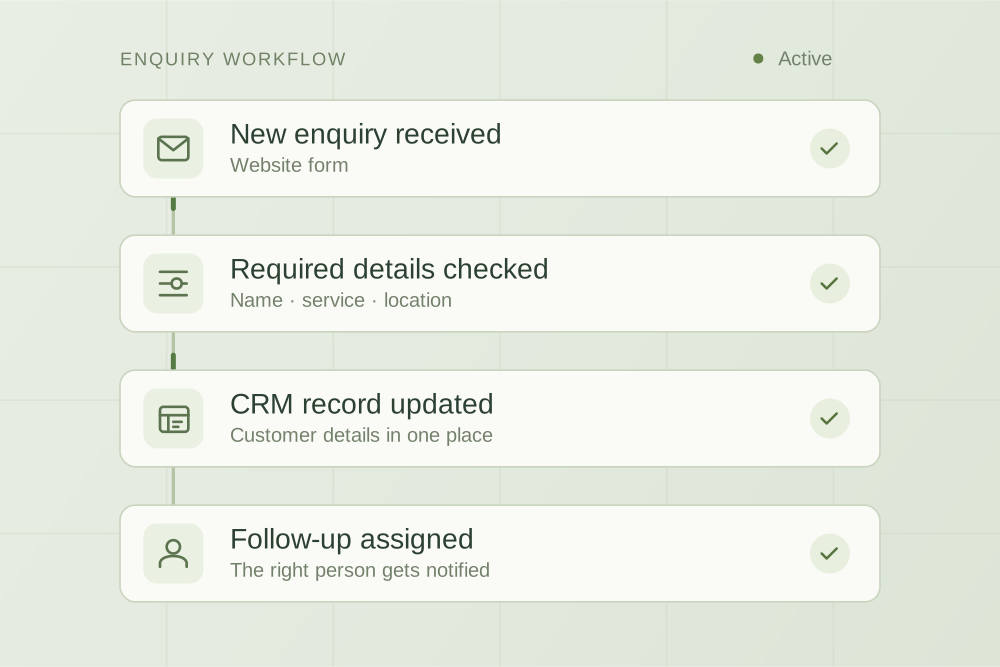
We build tailored AI systems, automations and business software around the way a business already operates. The starting point is a specific bottleneck: an enquiry that waits too long for a reply, details copied between tools, a follow-up that depends on someone remembering, or work that stalls between people.
Depending on the problem, the build might be a website and enquiry assistant, a CRM connection, a follow-up workflow, document collection or a custom internal tool. We check what your existing software can already do before recommending anything new.
For Emoney Home Loans, a mortgage-broking business whose website reports more than $10 billion in loans settled over its history, we rebuilt the website and added an AI assistant that gathers a visitor’s needs and passes that context to a broker. That figure is Emoney’s own lending volume, not a result of our work. The project story shows what we delivered and notes that we have not published performance figures for it.
Consider AppliedAgents when you want to improve a particular customer or operational process, and the work crosses your website, your business tools and the handoffs between your team.
Look elsewhere when the main requirement is organisation-wide data governance or a large platform migration. Compare providers with published examples at that scale.
Hourglass AI: a packaged rollout with published prices
Hourglass AI is a small Sydney and Melbourne team that launched in 2026. Its homepage says it is the best fit for Australian teams of 20 to 100 people with no in-house engineers. The offer has three steps: an audit, a series of builds and ongoing care.
A central part of the offer is what it calls a company “AI brain”, which draws on email, CRM, drives and meeting notes, with builds delivered inside tools the team already uses. It is also unusually clear about price. When we checked, its site listed a $2,500 audit, builds of $5,000 to $25,000 each and care of around $1,000 a month per build. The audit fee comes off the first build if you go ahead within 30 days. AI usage is not included: you pay the AI provider directly through your own account.
Its results page includes five named client stories, with figures taken from the clients’ own words or from usage logs Hourglass shared with them.
Consider Hourglass when you want a defined, priced programme to get a whole team using AI, with ongoing support.
Before engaging, check how its knowledge foundation fits your systems. Hourglass says builds run on your own accounts and you own the IP, so confirm what upkeep your team takes on, and whether a single focused workflow would meet your immediate need before you commission a broader rollout.
RUBIX: data foundations first
RUBIX describes itself as an independent Australian data and AI consultancy, founded in 2011. Its approach works through four layers in order: the data foundation, the use case, governance and then delivery. Engagements are fixed in scope; it publishes typical durations rather than prices.
That order matters when an AI project is held back by inconsistent records, unclear access permissions, disputed definitions or uncertainty about who owns the risk. RUBIX also publishes its own guide to Australian AI consulting firms, which explains where it sees its role compared with large advisory firms and narrow machine-learning specialists.
Consider RUBIX when trustworthy data and accountable AI use are central to the engagement.
Before engaging, ask what foundation work the first use case actually needs, what can wait, and which deliverables will show progress along the way.
4mation: AI inside a wider software build
4mation is a Sydney-led software company offering AI consulting, prototypes, integrations, chatbots and AI agents alongside custom software development.
Its published process runs from understanding the problem through design and prototyping, validation, engineering, deployment and continued improvement. That breadth is worth examining when the AI capability is one part of a larger application, portal or internal system.
Consider 4mation when you need to build or substantially change software as well as add AI features.
Before engaging, ask how the project separates the prototype from the production build, who maintains the integrations, and how a prototype that disappoints would change the proposed investment.
Mantel: enterprise AI and modernisation
Mantel, whose website is at mantelgroup.com.au, is a large Australian and New Zealand technology consultancy that describes itself as “Australia’s largest independent AI consultancy”. Its AI practice covers agentic AI development, legacy modernisation and AI governance, connected to wider digital, cloud, data and security work.
Its site includes case studies with organisations such as Lendi Group, Finsure and Deputy. Examples like these help a buyer judge whether its delivery experience matches a complex environment with established technology teams.
Consider Mantel when AI has to work across enterprise systems, several business units and formal governance requirements.
Before engaging, identify the platforms and internal owners involved, and ask who will actually deliver the work and how it will be supported after handover.
How we chose these five
We wanted a short list that covers the main kinds of AI work an Australian business might buy, from fixing one workflow in a small team to an enterprise programme. We kept to Australian firms whose main business is building AI and software, rather than general consulting, and that publish enough about their services for a buyer to judge the fit. We included ourselves because we publish this guide.
That leaves out many capable firms, including industry specialists. The large global consulting firms are a different kind of purchase, so we cover them separately below. Use the directories in the next section if you want a longer list.
Where to find more AI consultants in Australia
- AI Directory (Australian Government). Run by the National AI Centre in the Department of Industry, Science and Resources. It had 1,011 listings when we checked, and you can filter it by state, service, business area and industry. Firms nominate themselves. To qualify they need an ABN, a presence in Australia, existing customers or partners and clearly displayed AI services, and the National AI Centre says it evaluates each nomination against those criteria. Treat a listing as a starting point, not a recommendation.
- business.gov.au adviser finder. A government search for business advice services by topic and postcode, including an artificial intelligence topic. The services listed are run or supported by government, and many are free. They can help you think through where AI fits before you pay a firm, but they are advisers rather than builders.
- Clutch. A commercial reviews site that lists AI consultants in Australia with ratings, minimum project sizes, hourly rates and locations. Clutch says every review is checked by a human editor before it is published. Firms can pay for a higher position: sponsored listings, then firms with paid Verified badges, come first in the default order. Re-sort the list by Clutch Rank, which Clutch says sponsorship does not affect, then read the reviews from clients most like you.
Government supplier panels, such as the NSW ICT Services Scheme, are built for government buyers and approved non-agency buyers such as councils, universities and charities. They are not a buying route for most private businesses, although a panel listing tells you a firm has been through a government process.
What about Deloitte, PwC, KPMG, EY and Accenture?
All five have AI practices that serve Australian clients. Their AI pages cover strategy, data, governance, building AI solutions and large transformation programmes: Deloitte, PwC, KPMG, EY and Accenture.
They make sense when the work spans a large organisation, involves audit, risk or regulatory questions, or needs a big team for a long programme. For a business with a handful of staff and one process to fix, the same questions in the next section still apply. Ask who will actually do the work, what the first phase delivers and what it costs to reach a result you can use.
How to choose between them
Give every shortlisted firm the same short brief: one process, the problem it causes, the tools involved, who handles it today and the result you want. Then compare the answers on the same points.
- Relevant evidence. A working example close to your use case, with the firm’s actual role explained, tells you more than a client logo.
- Starting point. Configuration of software you already have, an integration, a custom build, data preparation or broader advice are very different purchases.
- Exceptions. Ask what happens when information is missing, a connection fails or the AI is uncertain, and which actions still need a person.
- Ownership. Clarify who controls the accounts, data, code and documentation if you change providers.
- Total cost. Include discovery, the build, software subscriptions, AI usage, support and your own team’s time.
Our guide to choosing an AI implementation partner turns these into specific questions, with an editable acceptance checklist you can use with any supplier, including us.
What will it cost?
These firms sell different things, so their fees are not directly comparable. A packaged audit and a multi-month data programme solve different problems. Ask for a written proposal that separates the first piece of work from ongoing software, usage and support costs, then compare the total cost of reaching an agreed result.
A small project that fixes one defined bottleneck can be a sensible first step. An organisation with fragmented data may need foundation work before any build will hold up. Our AI implementation cost guide breaks down the components and the questions to ask.
Does the newest AI model matter?
Model capability is one part of the decision, not the whole of it. Ask a provider to show how its chosen model performs on examples that look like your work, including the awkward ones. Output quality, cost, speed, data handling and reliability matter more than which release is newest, and sometimes a standard software feature or a simple rule does the job.
Start with the process you want to improve
Whichever firm you approach, bring a specific task, the tools you use and an example of where it breaks down. If enquiries, follow-up or everyday operations are getting stuck between your people and your software, we are happy to talk it through on a free strategy call.
Competitor details were taken from each firm’s public website on 26 October 2026 and rechecked on 31 October 2026. 4mation’s website was unavailable when we rechecked, so its details are from 26 October. Directory details were checked on 31 October 2026. Prices, team sizes and services change; confirm them directly with the firm. Corrections are welcome at jackson@appliedagents.com.au.

Practical thinking on AI, automation and the work behind a business.