Agencies keep saying SEO is dead and that AEO or GEO is the new game. So what is the real difference in AEO vs GEO vs SEO? Google says it is all still SEO. Here is what each term means, what really differs, what to ignore and a monthly check you can run yourself.
The short answer
SEO, AEO and GEO are three names for work that overlaps almost completely. SEO is getting your website found and trusted by search engines. AEO (answer engine optimisation) and GEO (generative engine optimisation) are newer labels for getting your business named or cited in AI answers, such as Google’s AI Overviews, ChatGPT search, Perplexity and Copilot. Google’s own guide says that “optimizing for generative AI search is optimizing for the search experience, and thus still SEO.” What really changes in practice: AI answers are assembled from several sources at once, the aim is to be named or cited rather than just ranked, you measure impressions and citations rather than clicks, and pages that answer a question or compare options honestly matter more. You can ignore llms.txt files, special “AI schema” and paid mentions. SEO is not dead. It just has a bigger job.
If you run a small business in Australia, you have probably had an email this year offering “AEO”, “GEO” or “AI SEO”. The pitch is usually that SEO is finished, that AI search is a new game, and that the agency has a special method for it. Some of that is true, some of it is a rebrand, and some of it is advice Google has publicly said you can skip.
This guide explains what each term means, what the search and AI companies actually publish, what is different in practice, what to ignore, and what to do. It is written for the owner, not the technician. If you want the step-by-step on getting named by ChatGPT in particular, we have a separate guide on how to get your business recommended by ChatGPT. This page is about the terms and the decisions.
Disclosure: Jackson Dong, who wrote this guide, founded AppliedAgents, which sells AI search optimisation, and Sylligence. Emoney Home Loans, the worked example below, is an AppliedAgents client. No business paid to be mentioned.
What SEO, AEO, GEO, LLM SEO and “AI SEO” mean
None of these terms has an official definition. Google defines only the acronyms: “AEO” stands for “answer engine optimization” and “GEO” for “generative engine optimization”, and it describes both as “terms you may see used to describe work specifically focused on improving visibility in AI search experiences.” The rest of the table is what people usually mean when they say each word.
| Term | What people usually mean | Where it shows up | What you measure |
|---|---|---|---|
| SEO (search engine optimisation) | Making your website easy for Google and Bing to crawl, understand and trust, so it appears when customers search. | Ordinary search results, Google Maps and the local pack, Shopping. | Rankings, impressions and clicks in Google Search Console, and enquiries from search in your analytics. |
| AEO (answer engine optimisation) | Writing pages that answer a customer’s question directly, so the answer itself can be quoted or summarised. | Featured snippets, “People also ask”, voice assistants, and increasingly AI Overviews. | Whether your page is quoted or linked in the answer. In Google, the Search Console generative AI report shows impressions. |
| GEO (generative engine optimisation) | Getting your business named, or your page cited as a source, in answers written by AI tools. | Google AI Overviews and AI Mode, ChatGPT search, Perplexity, Microsoft Copilot, Gemini. | Named or cited when you test real customer questions; Search Console generative AI impressions; Bing Webmaster Tools citations; customers who say “I found you through ChatGPT”. |
| LLM SEO | The same thing as GEO. People who like the technical name for the models (large language models) use this one. It is rare in Australian searches. | The same AI tools as GEO. | The same as GEO. |
| “AI SEO” | The catch-all most Australian agencies use on their service pages. Usually SEO plus GEO, sometimes with AI-written content thrown in. | Everywhere above. | Whatever the agency chooses to report. Ask which of the measures above they mean, and what the baseline is. |
In practice, the first three overlap so much that you cannot do one well without doing the others. A page that ranks in Google is also a page Google’s AI can draw from. A page that answers a question clearly is also a page ChatGPT can cite. The words matter less than the work.
What Google actually says
Google has published a guide called Optimizing your website for generative AI features on Google Search, last updated 10 July 2026. It is the closest thing to a straight answer on AEO vs GEO vs SEO, and it comes from the company that runs the search engine most Australians use. The key lines, quoted as written:
- On whether SEO still matters: “In short, yes! The best practices for SEO continue to be relevant because our generative AI features on Google Search are rooted in our core Search ranking and quality systems.”
- On the terms: “From Google Search’s perspective, optimizing for generative AI search is optimizing for the search experience, and thus still SEO.”
- On agencies: “If you’re considering third-party ‘AEO’ or ‘GEO’ advice or services, review our guidance on evaluating third-party SEO advice.” That guidance, Do you need an SEO?, asks two questions about any agency selling AEO or GEO: “is their advice aligned with Google Search’s official guidance on optimizing for generative AI features?” and “Do they cite official Google documentation as supporting evidence for their recommendations?”
- On guarantees: “No one can guarantee a #1 ranking on Google.” And: “If they guarantee you that their changes will give you first place in search results, find someone else.”
- On tools: “No third-party tool has access to our internal ranking or AI systems.”
Google’s companion page, AI features and your website, adds: “There are no additional requirements to appear in AI Overviews or AI Mode, nor other special optimizations necessary.” It also notes that AI Overviews “often don’t trigger”, because they appear only when Google decides they add something to the normal results.
The other platforms say less, but what they say points the same way. OpenAI’s crawler documentation says its search crawler, OAI-SearchBot, “is used to surface websites in search results in ChatGPT’s search features”, and that “Sites that are opted out of OAI-SearchBot will not be shown in ChatGPT search answers”. Perplexity’s crawler page says PerplexityBot “is designed to surface and link websites in search results on Perplexity”. Microsoft’s October 2026 note on its new content preferences says plainly: “Neither choice guarantees inclusion, traffic, or payment.” None of them describes a special file, tag or payment that gets you into answers.
What is actually different in practice
“Still SEO” does not mean nothing has changed. Four things are different enough that they change what you should build and how you judge the results.
1. Answers are assembled from several sources
A classic search result is a list. You rank, or you don’t. An AI answer is a paragraph stitched together from several pages. Google explains that its AI features use “query fan-out”, which it describes this way: “A set of concurrent, related queries generated by the model to request more information and fetch additional relevant search results to address the user’s query.” Its example: a search for “how to fix a lawn that’s full of weeds” might fan out into “best herbicides for lawns”, “remove weeds without chemicals” and “how to prevent weeds in lawn”. For a business, that means a customer’s one question becomes several behind the scenes, and your page gets a look if it answers one of those well.
2. The aim is to be named or cited, not just ranked
There are two ways to appear in an AI answer. You can be cited, which means your page is one of the linked sources. Or you can be named, which means the answer itself says your business name. They are not the same. A page can be used as a source for a comparison while the businesses it recommends are other people (we show a real case of that below). When you ask an agency what they will deliver, make them say which of the two they mean.
3. Measurement is different
Clicks were the measure for SEO. In AI search, the official reports mostly count something else:
- Google Search Console now has a Search generative AI performance report, announced 3 June 2026 and rolled out “to all websites worldwide” from 31 August 2026. It shows “how often URLs from your site appeared in generative AI features in Search and Discover”. It is impressions. The post does not mention clicks. Clicks from AI Overviews and AI Mode are mixed into the ordinary “Web” search type.
- Bing Webmaster Tools has an AI Performance report (public preview, 10 February 2026) showing “Total Citations”, “Average Cited Pages”, sampled “Grounding queries” and page-level citations for Copilot and Bing’s AI summaries. Microsoft says the data “represents a sample of overall citation activity” and “does not indicate ranking, authority, or the role of any page within an individual answer.” No clicks there either.
- ChatGPT and Perplexity publish no owner dashboard at all. You find out by asking the tools yourself, and by asking customers how they found you.
So if an agency shows you a chart of “AI visibility”, ask where the number came from. Google says no outside tool has access to its ranking or AI systems, so any third-party score is that tool’s own sampling, not Google’s data.
4. Answer and comparison pages matter more
Google says AI Mode “is particularly helpful for queries where further exploration, reasoning, or complex comparisons are needed”, and that people now ask “nuanced questions that might have previously taken multiple searches”, such as “comparing options”. When a customer asks an AI tool “who should I use for X and why”, the pages that answer that question honestly are the ones that get drawn in. Google’s content advice is to give “a unique point of view”, such as “a first-hand review” based on “personal experience”, and to avoid “commodity content” that “could originate from anyone”. For a small business, that usually means a plain page per real customer question, and a comparison page that says who you are and who else is worth considering.
What to ignore
Google’s guide has a section called “Mythbusting generative AI search: what you don’t need to do”. It says many suggested “hacks” “aren’t effective or supported by how Google Search actually works.” Here is its list, in Google’s words, plus two things we add ourselves.
- llms.txt files. Google: “You don’t need to create new machine readable files, AI text files, markup, or Markdown to appear in Google Search (including its generative AI capabilities), as Google Search itself doesn’t use them.” Having one “will neither harm nor help your site’s visibility or rankings in Google Search, as Google Search ignores them.” If an agency charges you for an llms.txt file, you are paying for something Google has said it ignores.
- Special “AI schema”. Google: “Structured data isn’t required for generative AI search, and there’s no special schema.org markup you need to add.” Normal structured data is still worth keeping for rich results, but there is no AI-specific version to buy.
- “Chunking” content for AI. Google: “There’s no requirement to break your content into tiny pieces for AI to better understand it.” And: “make pages for your audience, not just for generative AI search.”
- Rewriting your pages for AI. Google: “You don’t need to write in a specific way just for generative AI search. AI systems can understand synonyms and general meanings”. You don’t need to stuff pages with every variation of a phrase.
- Churning out a page for every possible question. Google warns that creating separate content for every search variation “primarily to manipulate rankings or generative AI responses in Google Search violates Google’s scaled content abuse spam policy.” It also calls this “an ineffective long-term strategy”.
- Paid or fake “mentions”. Google: “seeking inauthentic ‘mentions’ across the web isn’t as helpful as it might seem.” Its systems “focus on high-quality content while other systems block spam”. Paid articles dressed up as news, and bulk mentions nobody reads, fall into this bucket.
- Fake reviews and testimonials. These are the same inauthentic mentions, with the added problem that they can mislead customers. The ACCC’s advertising guidance says fake reviews or testimonials risk breaching the Australian Consumer Law. Earn real reviews instead. Our guide on asking for Google reviews covers how to do it within the rules.
- Guarantees of a #1 spot or guaranteed citations. Google says indexing and serving “aren’t guaranteed” and AI Overviews “often don’t trigger”. Microsoft says its settings do not guarantee “inclusion, traffic, or payment”. No platform describes any way to buy or lock in a place in an organic AI answer. A promise that you “will be cited” is a promise nobody controls.
What actually helps: an owner’s checklist
Everything below comes from the platform documentation or from what we have seen work for clients. None of it needs a new acronym.
- Let the crawlers in. Open yourbusiness.com.au/robots.txt. Make sure nothing blocks Googlebot, Bingbot, OAI-SearchBot (ChatGPT search) or PerplexityBot. If your site sits behind Cloudflare or another firewall, check its AI crawler settings too, because Perplexity notes that firewalls may need to “explicitly allow” its bots. OpenAI says robots.txt changes take “~24 hours” to apply. You can block GPTBot (used for training) and still allow OAI-SearchBot (used for search); OpenAI says “each setting is independent of the others”.
- Keep your Google Business Profile complete, and add Bing Places. Google’s checklist for AI features includes “checking that your Merchant Center and Business Profile information is up-to-date”, and its AI guide says Business Profiles “can help your products and services to be visible in both AI responses and other Google Search results.” Microsoft’s advice for appearing in Copilot and Bing’s AI summaries includes that businesses “register with Bing Places for Business”.
- Verify Search Console and Bing Webmaster Tools. Google says a site “must be included in Search generative AI features in Search Console” to be eligible, and there is now a toggle that can switch that off, so check it is on. Bing Webmaster Tools gives you the AI Performance report and IndexNow, which Microsoft says “helps keep information fresh across search and AI experiences.”
- Write answer pages for real customer questions. One clear page per question customers actually ask: what it costs, how long it takes, what is included, what can go wrong. Google asks for “a unique point of view” and first-hand experience, not “7 Tips” content that “could originate from anyone”. Write it the way you would explain it on the phone.
- Write a comparison page, with honest disclosure. If customers ask “who are the best X in [city]”, answer it. Include yourself, say clearly that you are one of the options and that nobody paid to be listed, and be fair to the others. A comparison that only recommends you reads as an advertisement, to people and to AI.
- Show real evidence. Microsoft’s advice for AI citations includes “support claims with evidence” and “strengthen depth and expertise”. Named clients (with consent), dated screenshots, real prices and real numbers. If you cannot show it, don’t claim it.
- Date your pages and keep the dates honest. Microsoft lists “keep content fresh and accurate” among the things that help. Put a visible “last updated” date on pages that change, and only change it when you actually update the content.
- Test monthly and keep a record. Use the check below. A slow trend over three or four months tells you more than any single answer.
How to check if AI search mentions you
This takes about 15 minutes a month. Use a private or temporary chat window so your own history does not shape the answers. Run each question in Google (look for the AI Overview, then try AI Mode), ChatGPT with search on, Perplexity and Copilot. Change the bracketed parts to fit your business.
1. Who are the best [service] providers in [city or region] for [specific need, for example “a first home”]?
2. [Your business] vs [a competitor]: which is better for [typical job]?
3. What does [service] cost in [city] in 2026, and who offers it?
4. I need [specific job] in [suburb] this week. Who should I call and why?
5. Is [your business name] any good? What do people say about them?
For each answer, record three things: whether you were named (your business name appears in the answer), whether you were cited (your website appears as a linked source), or whether you were absent. A simple spreadsheet is enough. One row per question, per engine, per month.
| Date | Engine | Question | Named | Cited | Who was named instead |
|---|---|---|---|---|---|
| 6 Nov 2026 | Google AI Overview | Q1 | No | Yes | Two competitors, one directory |
| 6 Nov 2026 | ChatGPT search | Q1 | Yes | Yes | One competitor |
| 6 Nov 2026 | Perplexity | Q1 | Absent | Absent | Three competitors |
One warning. Answers vary by person, place and day. Google says AI Overviews “often don’t trigger”, and that AI Mode and AI Overviews “may use different models and techniques, so the set of responses and links they show will vary.” Microsoft says its citation data is a sample. Someone in Perth may get a different answer from someone in Hobart asking the same question an hour later. Treat one screenshot as a data point, not a result. Three months of rows is a result.
Free AI search check
Want to know whether AI tools name your business? Talk with AppliedAgents. We test the questions your customers ask in Google’s AI Overviews, ChatGPT, Perplexity and Copilot, and send you the results in writing, free. If you go ahead, setup comes with our 30-day refund guarantee.
A worked example: 29 days to a citation, about three months to first place
Here is one dated case from our own work, with the disclosure first: Emoney Home Loans is an AppliedAgents client. We rebuilt its website and wrote its borrower guides, so we have an interest in this going well.
On 8 August 2026 Emoney published a comparison guide, best mortgage brokers for refinancing in Australia. It names several brokers, says which is better for which situation, includes Emoney as one option, and says so.
On 6 September 2026, 29 days later, a live check for “best refinance brokers” found Emoney’s guide as the first ordinary search result, and Google’s AI Overview used it as a source and named Emoney as a comparison resource. The brokers the AI recommended in that answer were other businesses. In the terms above: cited, and named as a resource, but not recommended.
By early November 2026, a check on google.com.au for “best mortgage brokers for refinancing” showed an AI Overview that opened with “Emoney Home Loans is a top-rated choice for review-first, ongoing broker support and custom home loan refinancing across Australia” and listed Emoney first in its table. On 6 November the guide was the second ordinary web result for the same search.
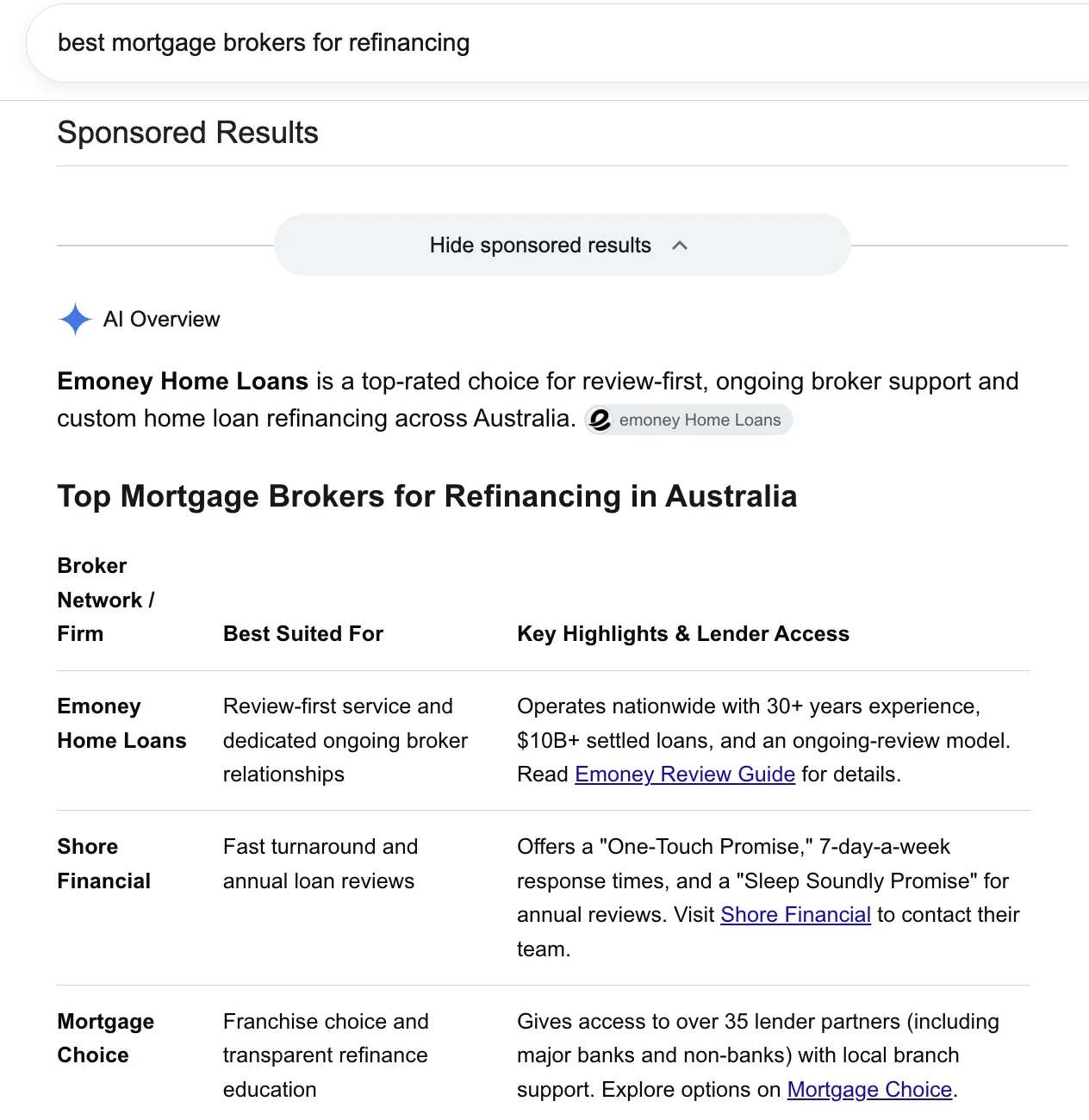
What we take from it, modestly: a plain, honest comparison page with a real point of view was drawn into an AI answer within a month, and the way it was used changed over the following weeks. The page was written for borrowers, and the site has no llms.txt file. We cannot promise the same timeline or outcome for anyone else, and the same question asked from a different place or on a different day can produce a different answer. For balance: our own site’s commercial pages do not yet rank well, even though our educational guides are picking up AI Overview impressions in Search Console.
Is SEO dead?
No. The evidence runs the other way. Google says its AI features “are rooted in our core Search ranking and quality systems”, and that to appear in them a page “must be indexed and eligible to be shown in Google Search with a snippet”. In other words, the entry ticket to AI Overviews is the same entry ticket as ordinary search. ChatGPT search and Perplexity both work by crawling the open web and linking to pages, which is what search engines have always done. AI Overviews also “often don’t trigger”, so for many searches the ordinary results are still all there is.
What has changed is the job description. Ranking alone no longer finishes the work, because a ranked page can be read by an AI and summarised with someone else’s name on the recommendation. The work now runs from being found, to being understood, to being named. Call it SEO, AEO or GEO. The checklist is the same.
If you only remember one thing: before you pay anyone for AEO or GEO, ask them to show you where their advice appears in Google’s own guide. Google asks you to do exactly that.
If you’d rather have someone do this
The checklist above is doable in a few evenings if you are comfortable with your website. If you’d rather hand it over, our AI search optimisation service starts with a free check and written findings, and the terms of our guarantee are on that page. If you are weighing up agencies, our comparison of AI SEO agencies in Australia sets out who publishes prices, proof and guarantees, with the disclosure that we are one of the agencies compared.
Sources
Platform documentation, read on 6 November 2026:
- Google Search Central, Optimizing your website for generative AI features on Google Search (last updated 10 July 2026)
- Google Search Central, AI features and your website (last updated 10 December 2025)
- Google Search Central, Do you need an SEO? (last updated 5 June 2026)
- Google Search Central blog, Introducing Search generative AI performance reports in Search Console (3 June 2026, updated 31 August 2026)
- OpenAI, Overview of OpenAI crawlers
- Perplexity, Perplexity crawlers
- Bing Webmaster Blog, Introducing AI Performance in Bing Webmaster Tools (public preview) (10 February 2026)
- Bing Blog, Your content, your choice: clearer preferences for training and grounding (30 October 2026)
Quotations keep their original American spelling. The Emoney observations are dated single checks from Australian connections and are not a guaranteed position. Jackson Dong, the author, founded AppliedAgents and Sylligence, Emoney is an AppliedAgents client, and no business paid to be mentioned. AI search changes quickly; we will update this guide when the platforms change what they publish.

Practical thinking on AI, automation and the work behind a business.